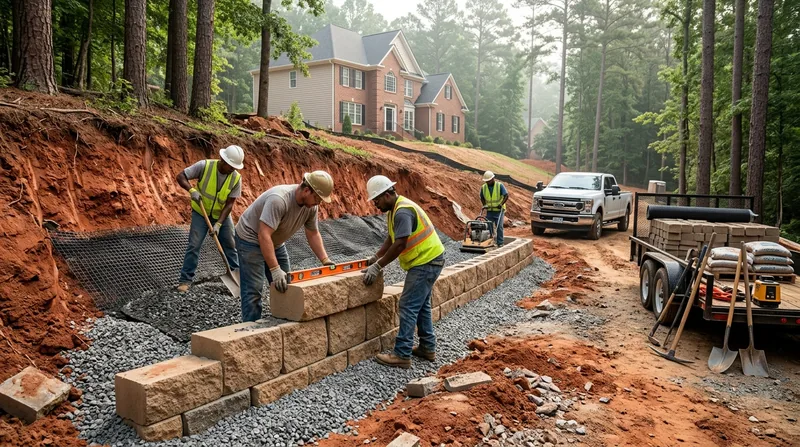




Raleigh sits right where the rolling upland clay belt meets the sandier Coastal Plain, so your backyard can be sticky red clay over weathered granite saprolite in Five Points and sticky clay that swells with every summer thunderstorm in North Raleigh. That shrink-swell cycle is exactly what pushes old timber and railroad tie walls out of plumb, and it is why Block & Segmental Retaining Walls in Raleigh have become the go-to fix for subdivision lots in Cary, Garner and Wake Forest. A mortarless Allan Block, Versa-Lok or Keystone wall flexes with the clay instead of cracking, and when we build it with geogrid and proper drainage it holds a terrace, a driveway cut or a garden bed for decades. We install engineered segmental walls for homeowners who are tired of patching a leaning wall every other spring. If you are still deciding between materials, start with our retaining wall installation overview, then call (984) 789-5415 for a free on-site look.
Why Segmental Block Walls Make Sense on Raleigh's Clay and Slopes
Most of the walls we tear out in Raleigh were never engineered for the soil they sit in. The red clay west and north of downtown soaks up hurricane rain, swells, and shoves the wall face forward, then shrinks in a July drought and leaves the blocks loose. Sandy loam toward Johnston County drains faster but scours out under a poorly set base. Segmental block handles both because each unit is independent, the wall is built on a compacted aggregate footing, and geogrid ties the block face back into the hillside.
- We set every wall on a excavated, compacted crushed-stone base, not on topsoil.
- We install geogrid in lifts behind the block to resist overturning and sliding.
- We backfill with free-draining gravel and pipe water to daylight, because hydrostatic pressure is what kills walls here.
- We cap the wall and compact the soil above it so runoff does not tunnel in behind the blocks.
- We keep curves and terraces tight to your property line and HOA setback rules.
Done this way, a segmental wall moves with the clay instead of fighting it, and it stays plumb through the wet season.
Key info: A Boylan Heights homeowner had a 3-foot railroad tie wall that had crept 8 inches downhill toward the alley. We replaced it with a Versa-Lok wall on a gravel base with geogrid and a French drain outlet, and it has stayed dead plumb through two hurricane seasons.
If you want the code side of the story, the City of Raleigh's permit portal at raleighnc.gov is the place to confirm whether your wall height or surcharge triggers an engineered drawing.
How We Build a Segmental Block Wall in Raleigh, Step by Step
Every wall starts with a site visit, because the block system, the geogrid layout and the drainage plan all depend on how tall the wall is and what sits above it. We measure from the proposed footing, check the slope, and look at where water currently runs. Then we lay out the wall on the ground so you can see the curve and the height before we cut a single block.
- We excavate and compact a level aggregate base trench below frost and grade.
- We set the first course dead level, because every course above it inherits that line.
- We stack the block, install geogrid at the engineered intervals, and pin it into the backfill.
- We place drainage gravel, filter fabric and a perforated outlet pipe behind the wall.
- We cap the wall, backfill and compact in lifts, then clean up and haul off spoil.
We walk the finished wall with you and show you where the drain daylights, so you know what to watch for in a heavy rain.
Key info: In an Apex cut-and-fill neighborhood off Kelly Road, a 6-foot tiered wall needed two geogrid lifts and an engineered detail because the driveway above it adds surcharge. We built it in two terraces with a planted bench, which also broke up the visual height.
See how we handle the same block systems in the 27604 area, or read up on retaining wall drainage if your current wall is seeping or staining.
Block Wall Approaches We Use Around Raleigh
The right system depends on wall height, the load above it, and how much room you have behind the face. Here is how the common approaches compare on Raleigh lots.
| Approach | Description | Best for |
|---|---|---|
| Allan Block | Mortarless pinless block with a rear lip, built with geogrid on taller walls. | Garden terraces and curved beds in Five Points and Hayes Barton. |
| Versa-Lok | Solid, heavy block with a pinned system for taller, load-bearing walls. | Driveway cuts and 4-foot-plus walls in North Raleigh subdivisions. |
| Keystone | Fiberglass-pin block with a proven geogrid connection for engineered walls. | Tiered retaining walls in Apex and Holly Springs new builds. |
| Tiered terraces | Two or three shorter walls with planted benches between them. | Sloped backyards where a single tall wall would look like a fortress. |
| Garden block walls | Low 12 to 24 inch walls with a simple gravel base and no geogrid. | Raised planting beds and mailbox walls in Oakwood and Boylan Heights. |
We spec the system to the wall, not the other way around, and we tell you when a low garden wall does not need the same engineering as a driveway wall.
Block & Segmental Retaining Walls Cost in Raleigh: What to Expect
Most segmental block walls in Raleigh start around $25 per square foot of wall face, and that figure climbs with height, geogrid, access and haul-off. A low garden wall in a Five Points backyard sits near the bottom of that range. A 5-foot engineered wall behind a Cary subdivision driveway sits well above it, because the geogrid, gravel backfill and engineering add real material and labor.
What moves the number: wall height and square footage, how tight the access is for a mini-excavator and pallets of block, how much clay spoil we have to haul off, whether the wall carries a surcharge like a driveway or patio, and whether the city requires a stamped drawing. Getting two or three estimates is smart because a contractor who quotes without probing the soil or checking the drain outlet is guessing.
Our pricing page breaks down the ranges in more detail, and the on-site estimate is free.
What to Look for When Hiring a Retaining Wall Contractor Near Me in Raleigh
Ask for the license and insurance certificate before anyone walks your slope, and confirm the coverage is current. Get at least two written estimates that spell out the block system, the base depth, the geogrid and the drainage, not just a square-foot price. Ask for references on walls at least three years old, because a wall that looks fine in month one can lean by year three if the drainage was skipped.
Check with the City of Raleigh or your county building department on permit thresholds, since walls over roughly 4 feet or walls carrying a surcharge often need a permit and sometimes an engineered drawing. If you are in an HOA neighborhood in Wake Forest or Holly Springs, get the architectural review approval in writing before we order block. Reach out through our contact page and we will walk you through what your specific wall needs.
Block & Segmental Retaining Walls in Raleigh: Pricing Guide
| Service | Price | Details |
|---|---|---|
| Garden block wall (under 3 ft) | Starting at $25/sq ft | Includes gravel base, block, cap and simple drainage; height and access move the price. |
| Engineered wall (4 to 6 ft) | Starting at $38/sq ft | Adds geogrid, gravel backfill, perforated drain and compaction; surcharge loads raise it. |
| Tiered or curved terrace wall | Starting at $45/sq ft | Multiple wall faces, benches and tighter layout work; slope and curve radius affect labor. |
| Large or engineered job | On estimate | Needs an on-site look for geogrid design, permit drawings and haul-off volume. |
| Travel | Included | In Raleigh and surrounding areas, no separate call-out or mileage fee. |
| Estimate | Free | Response within 24h at (984) 789-5415, no obligation to book. |
Indicative pricing, the exact cost depends on square footage, finish, and site access. Free personalized estimate within 24h at (984) 789-5415.


