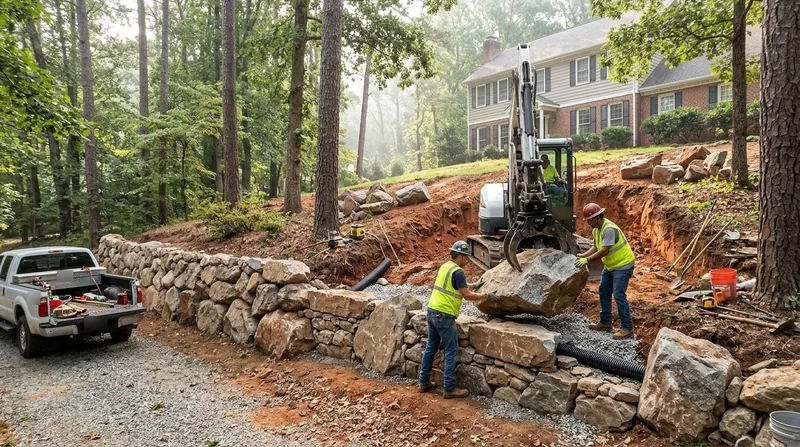




Raleigh sits where the rolling upland clay belt meets the sandier Coastal Plain, and that geology shows up in every backyard wall we build. Sticky red clay over weathered granite saprolite holds a boulder in place in Five Points, while the looser sandy loam toward Johnston County needs a deeper, wider base to keep a stone wall from settling. In Oakwood and Boylan Heights, old fieldstone garden walls step down sloped Victorian lots; out in Wake Forest and Holly Springs, newer cut-and-fill lots call for machine-placed granite that ties into the grade. If you want Boulder & Natural Stone Walls in Raleigh that look like they grew out of the loblolly pine woods instead of landing on top of them, we set every stone on a compacted base with drainage behind it. We handle the heavy lifting, the grade, and the tie-in to your existing landscape. Start with a look at our retaining wall installation process, then we walk your slope together.
Why Boulder and Natural Stone Walls Make Sense on Raleigh's Clay and Creek Slopes
Raleigh's red clay swells hard after a summer thunderstorm or a hurricane rain band, then shrinks in a dry October. A wall with no drainage behind it takes that pressure straight to the face, and that is the failure we see most: bulging, leaning, and stones working loose. Boulder walls handle the cycle well because gravity and mass do the work, but only when the base is dug below frost and the backfill drains.
- We dig the footing down to stable soil, not just scrape the topsoil off the clay.
- We set a compacted crushed stone base so the first course cannot sink into soft saprolite.
- We place granite and fieldstone with a machine and hand-fit the face for a natural look.
- We build a drainage plane and outlet behind the wall so storm water leaves instead of pushing.
- We tie the wall into the existing grade so runoff from the upslope does not pool at the face.
That combination is what keeps a stone wall standing through twenty Raleigh summers instead of five.
Key info: In Hayes Barton and Five Points, we regularly rebuild old brick and fieldstone garden walls that were laid without any drainage. The stone itself is usually fine. The missing gravel and outlet are what failed.
Before you plan a wall, check the City of Raleigh's permitting guidance at raleighnc.gov, because walls above roughly four feet or walls that carry a driveway or structure usually need a permit and sometimes engineered drawings.
How We Build a Boulder Wall on a Raleigh Slope
Every boulder wall starts with a site walk, because the grade, the soil, and the access decide the design. On a tight lot in Boylan Heights we may hand-carry stone down a narrow side yard; on a half-acre in Apex we can bring a mini-excavator and a stone grapple right to the line. We measure the slope, check where the water runs, and confirm the setback from the property line before anything gets delivered.
- We stake the wall line and confirm the height, batter, and setback with you on site.
- We excavate the footing trench and compact a crushed stone base to the required depth.
- We set the first course of granite or fieldstone level and true, stone by stone.
- We build the drainage plane, filter fabric, and gravel backfill as the wall rises.
- We place and fit the face stones, then cap the wall and backfill to grade.
- We clean the site, haul off spoil, and walk the finished wall with you.
If your slope is failing rather than just bare, we fold in slope stabilization and erosion control so the wall and the hillside work together.
Key info: A recent Garner job off Timber Drive had a rotting railroad tie wall holding back a sandy loam bank. We pulled the ties, over-excavated the soft soil, and set a granite boulder wall with a gravel drainage core. The homeowner finally stopped losing mulch into the creek after every storm.
Boulder and Natural Stone Wall Approaches We Use
Not every slope wants the same wall. A low garden terrace in a Five Points side yard and a tall hillside wall in Wake Forest are different jobs, and the stone, the base, and the equipment change with them. Here is how we match the approach to the site.
| Approach | Description | Best for |
|---|---|---|
| Granite boulder wall | Machine-placed granite boulders stacked with a slight batter and gravel backfill. | Taller hillside walls and creek-bank slopes. |
| Fieldstone garden wall | Hand-fit local fieldstone laid on a compacted base with a finished cap. | Low terraces and historic-lot garden walls. |
| Dry-stacked stone wall | Stone fitted without mortar, relying on gravity and careful pinning. | Walls under about three feet with good drainage. |
| Mortared stone veneer wall | A structural core faced with mortared natural stone for a clean finish. | Visible walls near patios and entries. |
| Boulder toe and slope armor | Boulders set at the toe of a slope to stop erosion and hold the bank. | Creek valleys and eroding sandy loam banks. |
We pick the approach after we see the soil and the water, not before, because the wrong stone on the wrong base is how walls fail.
Boulder & Natural Stone Walls Cost in Raleigh: What to Expect
Most boulder and natural stone walls in Raleigh start around $25 per square foot of wall face, and that figure moves with height, stone type, access, and how much excavation the slope demands. A low fieldstone terrace on a flat Five Points lot sits near the low end. A tall granite wall on a steep Wake Forest hillside with limited machine access sits well above it, because every stone gets handled more than once.
Stone choice matters too. Local granite boulders cost more per ton than fieldstone, but they need fewer pieces per square foot. A wall that carries a driveway or a structure may need engineered drawings, which adds design cost before a single stone is set. Tight side yards, mature loblolly pines in the work zone, and long haul distances for the stone all push the number up.
Get two or three written estimates with the same scope so you can compare base depth, drainage, and stone type line by line. Our full pricing overview breaks down what drives the range.
Boulder & Natural Stone Walls Near Me: What to Look for When Hiring a Retaining Wall Contractor near Raleigh
Any contractor can drop boulders on a slope. The difference shows up two winters later when the clay has swelled and shrunk once. Ask for proof of license and insurance, then ask how they handle drainage and base depth, because those two answers tell you whether the wall will last.
- Confirm the contractor is fully insured and ask for a certificate before work starts.
- Get multiple written estimates with the same scope so you compare base, drainage, and stone.
- Ask for references from walls at least three years old and go look at them.
- Ask who pulls the permit if your wall is over four feet or carries a surcharge.
- Check HOA rules for wall height, stone color, and setbacks before you order material.
When you are ready to talk through your slope, reach out through our contact page and we will set a time to walk it with you.
Boulder & Natural Stone Walls in Raleigh: Pricing Guide
| Service | Price | Details |
|---|---|---|
| Fieldstone garden wall, low terrace | Starting at $25/sq ft | Hand-fit fieldstone on a compacted base, best on flat lots with easy access |
| Granite boulder wall, mid-height | Starting at $38/sq ft | Machine-placed granite with gravel drainage core, price rises with wall height |
| Tall or tiered engineered wall | On estimate | Needs stamped drawings and deeper footing, so we price it after a site walk |
| Boulder toe and slope armor | Starting at $30/sq ft | Bank protection along creek valleys, driven by slope length and stone haul distance |
| Travel | Included | in Raleigh and surrounding areas, no separate call-out or mileage fee |
| Estimate | Free | Response within 24h at (984) 789-5415, no obligation to book |
Indicative pricing, the exact cost depends on square footage, finish, and site access. Free personalized estimate within 24h at (984) 789-5415.


