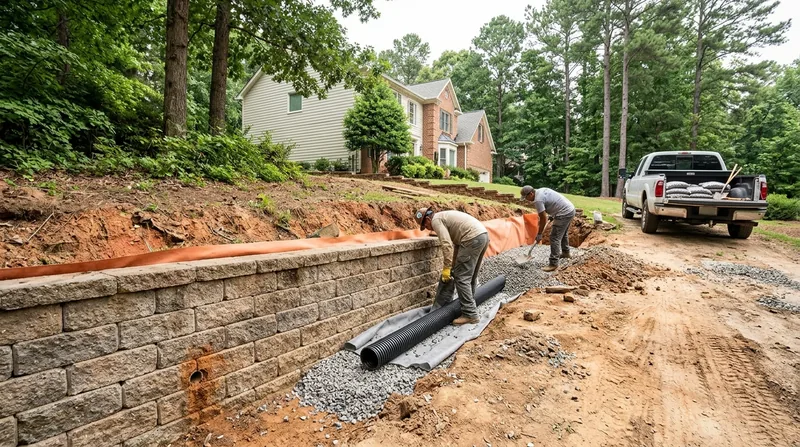




If you own a wall in Raleigh, the soil behind it is the real enemy. Raleigh sits where the rolling upland clay belt meets the sandier Coastal Plain, so you get sticky red clay over weathered granite saprolite west and north of downtown, and looser sandy loam out toward Johnston County. That clay swells hard during summer thunderstorms and hurricane rain, then shrinks in drought. A wall with no drainage behind it takes that pressure straight on the face. Proper Retaining Wall Drainage in Raleigh relieves hydrostatic pressure before it pushes the wall out of plumb. We build French drains, weep holes, gravel backfill and waterproofing that move water away from the wall and keep it moving. If your wall is already leaning, start with our leaning and collapsed wall repair page, then we address drainage so it does not happen twice.
Why Drainage Fails Behind Walls in Raleigh's Clay Belt
Most wall failures we see in Raleigh are not block failures. They are water failures. Sticky red clay holds rain like a sponge, then expands against the back of the wall. When the soil dries, it pulls away and opens cracks that channel water straight down. In Hayes Barton and Five Points, we find 1920s garden walls with no drain at all, just soil packed against old brick. In 1980s and 1990s Cary and Garner subdivisions, rotting landscape timber and railroad tie walls trap water until the ties give out. Newer cut-and-fill neighborhoods in Apex, Holly Springs and Wake Forest rely on tall segmental block walls that need real drainage or they lean.
- Hydrostatic pressure builds when saturated clay cannot drain, and it pushes the wall face outward.
- Frozen or drought-shrunk backfill leaves voids that collapse and shift the wall.
- Clogged or missing weep holes let water sit behind the block instead of escaping.
- Downspouts and gutter outlets dump roof water directly behind the wall.
- Tree roots and loblolly pine roots crack drainage pipe and block flow.
Fixing the drainage is almost always cheaper than rebuilding the wall, so we check the drain first on every repair call.
Key info: A Boylan Heights homeowner called us about a brick garden wall that had leaned six inches toward the rail yard. The wall was fine. The 90-year-old clay backfill had no weep holes and the gutter dumped right behind it. We cut in new weep holes, added gravel backfill and a French drain, and reset the wall for a fraction of replacement cost.
For the official rules on walls, footings and drainage, check the City of Raleigh's permit information at raleighnc.gov, and always confirm thresholds with the local building department.
How We Fix Retaining Wall Drainage in Raleigh
We work from the soil and the water, not from a catalog. Every job starts with a walk of the wall and a look at where water actually goes. We check the slope above the wall, the gutter outlets, the soil type and the wall material. Then we build a drain that fits that wall, whether it is old brick in Oakwood or a tall segmental block wall in Wake Forest.
- We inspect the wall face, footing and backfill, and we probe the soil to see how much clay we are dealing with.
- We map the water path, including roof runoff, gutter outlets and surface flow from uphill.
- We excavate behind the wall and remove saturated or unsuitable backfill.
- We install perforated drain pipe in a gravel envelope, wrapped in filter fabric to keep clay out.
- We cut weep holes at the base and set gravel behind them so water can escape.
- We waterproof the wall face where the material calls for it, then backfill with free-draining gravel.
- We tie downspouts and surface drains into the system and discharge water to daylight, away from the wall.
The goal is simple: water goes into the pipe and out to daylight, never into the clay behind the wall.
Key info: In a 1990s Garner subdivision, a railroad tie wall was bowing out under a pine tree. The ties were rotten and the backfill was pure clay with no drain. We replaced the ties with segmental block and built a French drain with gravel backfill and a fabric-wrapped pipe that discharges to the swale. That wall now sheds water instead of holding it. See our railroad tie wall replacement page for that scope.
Drainage Approaches We Use on Raleigh Walls
There is no single drain for every wall. The right approach depends on wall height, material, soil and how much water the site sends at it. Here is how we match the method to the wall.
| Approach | Description | Best for |
|---|---|---|
| French drain behind the wall | Perforated pipe in a gravel envelope, wrapped in filter fabric, discharging to daylight. | Tall block and concrete walls holding back clay |
| Weep holes and gravel backfill | Openings at the base with clean gravel behind them so water exits the face. | Brick, stone and older garden walls |
| Wall-face waterproofing | Membrane or coating on the back of the wall to keep water out of the material. | Poured concrete and block walls in wet soil |
| Surface water control | Regrading, swales and downspout tie-ins that keep roof and slope water away. | Walls at the bottom of a slope or under a roofline |
| Drainage during replacement | New drain and gravel built in as the old wall comes out and the new one goes in. | Failed timber and railroad tie walls |
We pick the method after we see the water, not before, because the wrong drain just moves the problem.
Retaining Wall Drainage Cost in Raleigh: What to Expect
Drainage work starts at From $2,500 for a typical residential wall, and that figure covers the real work: excavation behind the wall, drain pipe, gravel, filter fabric, weep holes and discharge to daylight. The number moves with wall length and height, how much saturated clay we have to remove, access for equipment, and whether the wall needs face waterproofing. A short garden wall in Five Points costs less than a tall segmental wall in Wake Forest with a long run to daylight.
If the wall is already leaning or the timber is rotten, drainage alone will not save it, and we tell you that up front. In those cases the drain gets built during repair or replacement, which is why we quote the whole scope instead of a drain in isolation. Getting two or three estimates is smart, and so is asking each contractor where the water will discharge. A cheap drain that dumps water at the neighbor's property line is not a fix. Our pricing overview lays out the ranges in more detail.
Retaining Wall Drainage Near Me: How to Hire in Raleigh
When you search for retaining wall drainage near me in Raleigh, you will get a long list. Here is how to sort it. Ask for proof of license and insurance before anyone digs, and ask what happens to the water when the job is done. A contractor who cannot answer that is guessing.
- Confirm the company is fully insured, and ask for a certificate before work starts.
- Get two or three written estimates with the drain type, pipe size and discharge point spelled out.
- Ask for references from walls of similar height and soil, not just any wall.
- Check permit requirements with the local building department, especially for walls over roughly 4 feet or walls supporting a driveway or structure.
- Ask about HOA rules and property-line setbacks before you dig, since drainage discharge can cross a line.
We are happy to walk the wall with you and put the scope in writing. Reach us through our contact page to set up a free estimate at (984) 789-5415.
Retaining Wall Drainage in Raleigh: Pricing Guide
| Service | Price | Details |
|---|---|---|
| Weep holes and gravel backfill | Starting at $2,500 | Covers excavation, clean gravel, filter fabric and weep holes on a typical residential wall run. |
| French drain behind existing wall | Starting at $3,200 | Includes perforated pipe, gravel envelope, fabric wrap and discharge to daylight, priced by wall length. |
| Drainage with wall repair or replacement | On estimate | Needs an on-site look because wall height, timber rot and access change the scope. |
| Wall-face waterproofing add-on | Starting at $850 | Membrane or coating on the back of concrete and block walls in wet clay soil. |
| Travel | Included | In Raleigh and surrounding areas, no separate call-out or mileage fee. |
| Estimate | Free | Response within 24h at (984) 789-5415, no obligation to book. |
Indicative pricing, the exact cost depends on square footage, finish, and site access. Free personalized estimate within 24h at (984) 789-5415.


