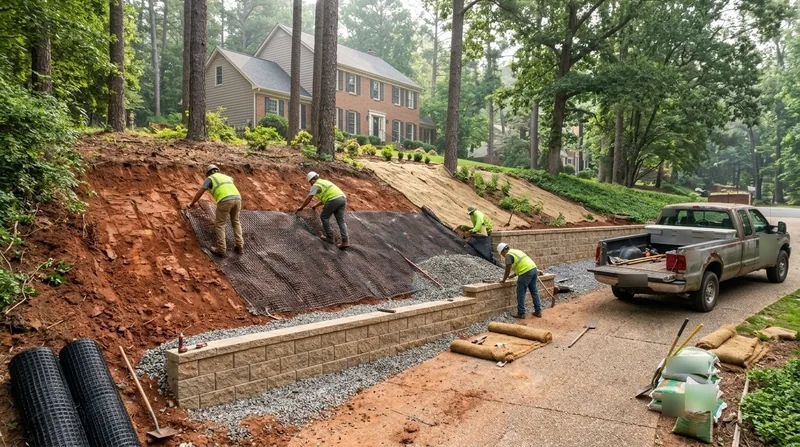




Slope Stabilization & Erosion Control in Raleigh: Built for Red Clay and Creek Valleys
Raleigh sits on a tricky seam. West and north of downtown, you get sticky red clay over weathered granite saprolite. East toward Johnston County, the ground loosens into sandy loam. Crabtree, Walnut, and House Creek cut through it all, and every summer thunderstorm or hurricane remnant sends water sheeting down slopes that were never built to handle it. That is where Slope Stabilization & Erosion Control in Raleigh becomes a homeowner's problem, not a contractor's buzzword. If your yard drops toward a creek, your driveway sits on fill, or your 1980s Cary subdivision lot has a timber wall quietly rotting into the hillside, we stabilize the grade before the next storm takes it. Start with a look at our retaining wall installation work if you are at the planning stage.
Why Slopes Fail Here: Raleigh's Clay Belt and Creek Valleys
Clay is the villain. It swells when it soaks up a July downpour, then shrinks hard in a dry October, and that cycle opens cracks, shifts footings, and pushes water behind walls that have no drainage. In Five Points and Hayes Barton, we see 1920s brick and fieldstone garden walls bulging from saturated soil. In Boylan Heights, lots step down toward the rail yards and sheet flow erodes the toe of the slope. Out in Apex, Holly Springs, and Wake Forest, newer cut-and-fill lots rely on tall segmental block walls that only hold if the geogrid and drainage were installed correctly.
- Water pools behind a wall because the backfill was never graded to drain, and hydrostatic pressure pushes the wall face outward.
- Tree roots die or get cut during grading, and the soil loses the structure that held it on the slope.
- Downspouts and driveway runoff dump concentrated flow onto a bank that was stable before the gutters were rerouted.
- Old timber and railroad tie walls in 1980s and 1990s Garner and Cary subdivisions rot at the soil line and fail without warning.
- Creek bank undercutting along Crabtree and Walnut tributaries eats away the toe until the slope above slumps.
Every one of these failures starts with water management, and every fix we build starts there too.
Key info: A homeowner in the 27607 zip code near Crabtree Creek had a 3-foot timber wall that looked fine in spring. After two hurricane-season rain events, the clay behind it swelled and the wall leaned 6 inches in a month. The fix was a drained segmental block wall with geogrid, not a patch job.
For official guidance on grading and stormwater rules, check the City of Raleigh site before you dig.
How We Stabilize a Raleigh Slope: Step by Step
We do not guess at a slope. We walk the grade, check where water enters and exits, and look at what is under the grass. Then we build a plan around the actual soil, the actual drainage pattern, and the actual load above the wall. On cut-and-fill lots in Holly Springs and Wake Forest, that often means terraced walls rather than one tall face, because tiering spreads the load and lets us plant between the tiers.
- We walk the slope and mark the flow paths where stormwater concentrates during a heavy rain.
- We probe the soil to confirm clay depth versus sandy loam and check for fill soil that was never compacted.
- We design the wall height, tier spacing, and geogrid layout to match the load above and the setback rules for the jurisdiction.
- We excavate and install a compacted aggregate base with proper embedment below grade.
- We lay drainage aggregate, filter fabric, and perforated pipe behind the wall, then daylight the outlet so water has somewhere to go.
- We place geogrid in the designed layers and compact the backfill in lifts, not in one dump.
- We finish the grade above the wall so surface water runs away from the face, then seed or plant the disturbed areas.
Each step exists because skipping it is how walls lean, settle, and fail in the first place.
Key info: In a Five Points backyard, a 1920s brick garden wall was holding a slope above a basement walkout. We kept the historic brick face, rebuilt the drainage behind it, and tied it into a new geogrid-reinforced section. The homeowner kept the look and lost the leak. See our retaining wall repair page for more on saving existing walls.
Slope Stabilization Methods We Use in Raleigh
Not every slope needs the same solution. A creek bank in Garner is a different problem from a driveway cut in Apex. Here is how we match the method to the site.
| Approach | Description | Best for |
|---|---|---|
| Terraced segmental block walls | Tiered block walls with geogrid reinforcement and drainage aggregate behind each tier. | Tall cut-and-fill lots in Apex, Holly Springs, and Wake Forest. |
| Boulder and natural stone toe walls | Rock placed at the base of a slope to stop undercutting and hold the toe. | Creek banks and wooded slopes along Crabtree and Walnut tributaries. |
| Drainage and surface water control | Perforated pipe, filter fabric, graded swales, and downspout extensions that move water away from the slope. | Any slope where water pools or sheets over the edge. |
| Erosion control blankets and vegetation | Temporary blankets and native plantings that hold bare soil until roots take over. | Freshly graded banks and disturbed areas after wall work. |
| Replacement of failed timber and tie walls | Removing rotting timber, rebuilding with block or boulder, and adding drainage. | 1980s and 1990s subdivisions in Cary, Garner, and North Raleigh. |
We pick the method after we see the water, not before.
Slope Stabilization & Erosion Control Cost in Raleigh: What to Expect
Cost depends on the slope, not on a flat rate. A short boulder toe wall on a Garner creek bank is a different job from a terraced 8-foot block wall with geogrid above a Wake Forest driveway. We start every job with a free estimate, and we tell you what drives the number before you commit. The biggest cost factors are wall height and length, access for equipment, soil type (clay costs more to excavate and haul than sandy loam), how much drainage work is needed, and whether the slope sits close to a house, driveway, or property line.
Get two or three estimates for any job over a few thousand dollars. A contractor who walks the slope, probes the soil, and explains the drainage plan is giving you a real number. One who quotes from the curb is guessing. Our pricing page lays out how we structure estimates so you can compare apples to apples.
Key info: A homeowner in Garner's 27603 zip code got three quotes for a failing railroad tie wall. Two were patch proposals. The third included drainage and geogrid. Two years later, the patched walls from the other bids had already shifted. The drained wall has not moved.
Hiring a Slope Stabilization Contractor Near Me in Raleigh: What to Check
Slope work is not a weekend DIY project, and not every landscaper is set up for it. Before you sign, verify the basics. Ask for the license and insurance certificate, and call the references on jobs that look like yours, not just the easy ones. Ask who pulls the permit and whether engineered drawings are needed for your wall height. In Raleigh, walls above roughly 4 feet from the footing, or walls that support a driveway or structure, often need a permit, and thresholds vary by jurisdiction, so confirm with the local building department. If your lot is in an HOA, get the architectural review done before the first shovel hits the dirt.
Reach out through our contact page to set up a walk-through.
For a closer look at work in your part of Wake County, see our 27604 service page or the Cary 27513 page.
Slope Stabilization & Erosion Control in Raleigh: Pricing Guide
| Service | Price | Details |
|---|---|---|
| Slope stabilization consultation | Free estimate | On-site walk of the slope, drainage check, and soil probe, with a written scope and no obligation to book. |
| Boulder toe wall or small erosion repair | Starting at $1,800 | Short rock toe wall with drainage aggregate; final price moves with slope height and equipment access. |
| Terraced segmental block wall with geogrid | Starting at $45 per square foot | Engineered tiers, geogrid, drainage pipe, and compacted backfill; clay soil and tight access raise the rate. |
| Failed timber or railroad tie wall replacement | On estimate | Removal of rotting timber, haul-off, and rebuild with block or boulder; scope depends on wall length and buried debris. |
| Complex or large-scale slope job | On estimate | Tall walls, creek bank work, or slopes near structures need an on-site look and possibly engineered drawings before pricing. |
| Travel | Included | In Raleigh and surrounding Wake County areas, with no separate call-out or mileage fee. |
Indicative pricing, the exact cost depends on square footage, finish, and site access. Free personalized estimate within 24h at (984) 789-5415.


