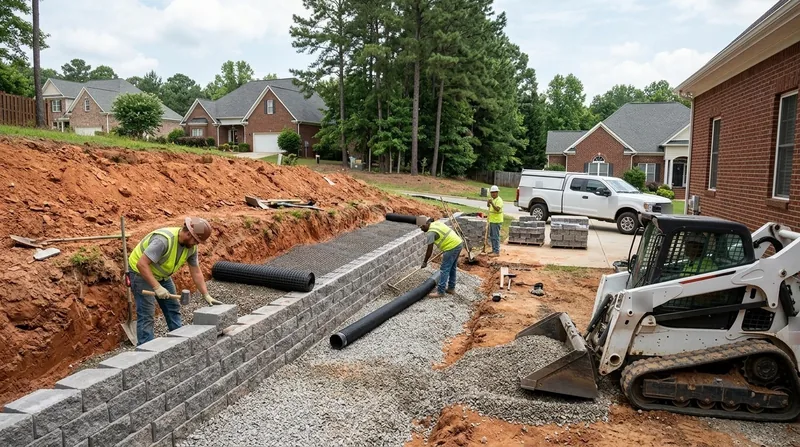




Raleigh sits on a tricky seam where the rolling upland clay belt meets the sandier Coastal Plain. In Five Points and Hayes Barton you find 1920s brick and fieldstone garden walls holding back sticky red clay, while newer cut-and-fill subdivisions in Apex and Wake Forest lean on tall segmental block walls. When summer thunderstorms and hurricane rain soak that clay, it swells, and in drought it shrinks, and any wall without proper drainage starts to lean. Retaining Wall Installation in Raleigh means building a wall that handles that clay movement from the footing up, not just stacking block on dirt. We design and build new walls for sloped yards, driveway cuts and terraced gardens with gravel backfill, perforated pipe and proper footings so wet red clay cannot push the wall out of line. If you already have a wall that is bowing or cracking, start with retaining wall repair before the problem gets worse. Call (984) 789-5415 to get a free on-site estimate.
Why New Retaining Wall Installation Matters in Raleigh's Clay Belt
Most wall failures we see in Raleigh trace back to water, not bad block. The red clay over weathered granite saprolite in the west and north holds moisture for days after a storm, and the looser sandy loam toward Johnston County drains faster but still shifts. A wall built without a gravel drainage zone and outlet pipe has nowhere for that water to go, so hydrostatic pressure pushes it forward until it leans or collapses. New installation done right prevents that cycle from starting.
- We excavate a proper footing below the frost line and compact base material before any block goes down.
- We install perforated drain pipe and washed gravel backfill behind every wall to move water away from the clay.
- We tie segmental block courses together with geogrid where the wall height or surcharge load demands it.
- We shape the grade above and below the wall so runoff drains away instead of pooling at the base.
Getting the drainage and footing right on day one is what separates a wall that lasts 30 years from one that leans in five.
Key info: A homeowner in Boylan Heights had a 3-foot timber wall along their side yard that rotted out after 20 years. We replaced it with a segmental block wall on a compacted gravel footing with a drain pipe daylighting at the street, and it has handled three hurricane seasons without movement.
Before you build, check the City of Raleigh's permitting guidance at raleighnc.gov because walls over roughly 4 feet from the footing, or walls supporting a driveway or structure, often need a permit and sometimes engineered drawings.
How We Build a Retaining Wall in Raleigh, Step by Step
Every installation starts with a site visit to read the slope, the soil and the water path. We check where runoff comes from uphill, how much room you have for a footing, and whether the wall will carry a surcharge like a driveway or patio. Then we lay out the wall line, confirm utility locates, and set a construction sequence that keeps your yard usable.
- We stake the wall line and verify setbacks and property lines before digging.
- We excavate and compact a gravel footing sized for the wall height and soil type.
- We set the first course dead level, because every course above depends on it.
- We install drain pipe, gravel backfill and filter fabric as the wall rises.
- We place geogrid in lifts where engineering calls for it and compact each lift.
- We cap the wall, backfill the grade and clean the site before we leave.
That sequence is the same whether we are building a 2-foot garden wall in Oakwood or a 6-foot block wall in a Holly Springs subdivision.
Key info: In a Wake Forest cut-and-fill neighborhood, a homeowner needed a 5-foot wall to hold a driveway cut. We used segmental block with geogrid every other course and a drain outlet to the storm swale, and the wall has stayed plumb through two wet springs. See our Wake Forest installation page for local details.
Retaining Wall Methods We Use Across Raleigh
The right wall material depends on height, load, budget and the look you want. We build with segmental block, poured concrete, natural stone and timber, and we match the method to the site rather than forcing one system everywhere. Here is how the main approaches compare.
| Approach | Description | Best for |
|---|---|---|
| Segmental block | Interlocking concrete block with gravel core fill and geogrid reinforcement. | Tall walls, driveway cuts and tiered subdivision lots. |
| Poured concrete | Cast-in-place reinforced wall with formed face and drain system. | Structural walls carrying heavy surcharge or tight property lines. |
| Boulder and natural stone | Gravity wall built from stacked rock with gravel backfill. | Garden terraces, rustic landscapes and shorter walls. |
| Timber | Pressure-treated timbers pinned and backfilled with gravel. | Low garden walls and budget-conscious replacements. |
We will recommend the method that fits your slope, soil and budget, and explain why it fits before you commit.
Retaining Wall Installation Cost in Raleigh: What to Expect
Most new retaining walls in Raleigh start around $30 per square foot of wall face, and that figure moves based on height, material, access and soil conditions. A 2-foot garden wall in Five Points costs far less per square foot than a 6-foot engineered block wall in Apex with geogrid and a tight backyard. Access matters too: a wall you can reach with a mini excavator is cheaper than one you have to hand-dig behind a fence.
Material choice is the biggest swing. Timber is the least expensive upfront but has the shortest life in wet clay. Segmental block sits in the middle and lasts decades. Poured concrete and natural boulder walls cost more but handle heavy loads and tight sites. Site work, drainage and hauling off spoil all add to the number, and so does any engineering required for a tall or tiered wall.
Getting two or three estimates is smart because wall pricing varies widely depending on how each contractor handles drainage and footing. A low bid that skips the drain pipe is not a bargain. Our full breakdown lives on the retaining wall pricing page, and we are glad to walk you through it line by line.
Hiring a Retaining Wall Installation Contractor Near Me in Raleigh
Ask three things before you sign: is the contractor fully insured, can they show you walls they built two or three years ago that are still plumb, and do they pull permits when the wall needs one. A contractor who skips permits on a 5-foot wall is setting you up for trouble at resale. Ask for references in Raleigh neighborhoods similar to yours and call them.
Check HOA rules before you build, especially in Cary and Garner subdivisions where wall height and material may be restricted. If your lot has protected trees or heritage oaks near the wall line, confirm what the city requires before excavation starts. A good contractor will flag those issues during the estimate, not after the crew shows up.
Reach out through our contact page to schedule a free estimate and get a straight answer on what your wall needs.
Retaining Wall Installation in Raleigh: Pricing Guide
| Service | Price | Details |
|---|---|---|
| Low garden wall (up to 2 ft) | Starting at $30/sq ft | Includes compacted gravel footing, block or timber face and basic drainage; height and access move the price. |
| Standard block wall (3 to 4 ft) | Starting at $45/sq ft | Includes geogrid where needed, gravel backfill and drain pipe; soil type and slope add cost. |
| Engineered tall or tiered wall | On estimate | Requires on-site review of surcharge, soil and engineering needs before we quote a number. |
| Boulder or natural stone wall | Starting at $55/sq ft | Includes rock selection, gravity placement and gravel backfill; haul distance and rock size affect price. |
| Travel | Included | In Raleigh and surrounding areas, no separate call-out or mileage fee. |
| Estimate | Free | Response within 24h at (984) 789-5415, no obligation to book. |
Indicative pricing, the exact cost depends on square footage, finish, and site access. Free personalized estimate within 24h at (984) 789-5415.


