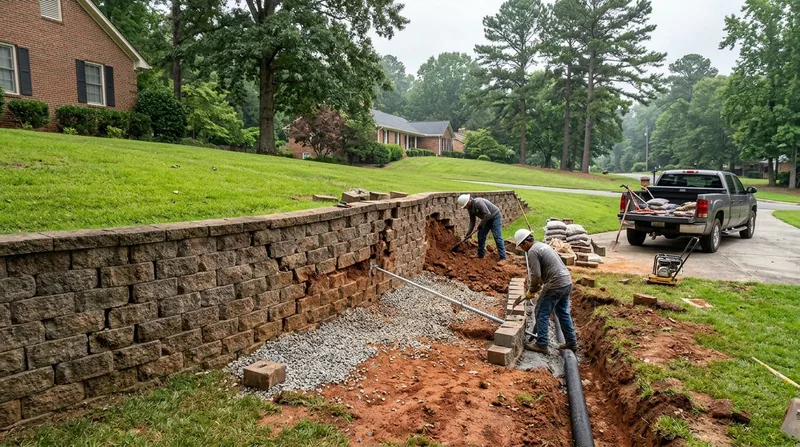




Leaning & Collapsed Wall Repair in Raleigh: When Clay Pushes Back
Raleigh sits on a stubborn seam of red clay that swells with every summer thunderstorm and shrinks hard in drought, and that cycle is what tips most retaining walls in this city. Whether you are in Leaning & Collapsed Wall Repair in Raleigh territory on a 1920s Hayes Barton garden wall or watching a 1990s Cary subdivision timber wall bow out toward the sidewalk, the cause is usually the same: water with nowhere to go. We respond fast to bulging, tilting, and fallen walls across Raleigh and the surrounding towns, stabilize what can be saved, and rebuild what cannot.
From the Victorian lots of Oakwood down to the rail-yard slope in Boylan Heights, old brick and fieldstone walls are failing quietly, while newer segmental block walls in Apex and Wake Forest lean because the drainage behind them was never built right. You get a straight answer on whether to anchor, rebuild, or replace. Start with our retaining wall repair service if the wall is still standing but out of plumb.
Why Leaning Walls Are So Common on Raleigh's Clay Belt
Raleigh's soil is the engine of the problem. West and north of downtown you get sticky red clay over weathered granite saprolite that holds water like a sponge, then dries and cracks. Toward Johnston County the ground turns to looser sandy loam that scours out under footings after a heavy rain. Add tall loblolly pines whose roots lift and shift shallow wall bases, and you get a city where hydrostatic pressure is the number one wall killer.
Most failures we see fall into a few clear patterns:
- The wall bulges outward at mid-height because saturated clay is pushing against a backfill that has no relief drain.
- The top course tips toward the yard after the footing settles on one side, common on older Five Points brick walls.
- Timber and railroad tie walls in 1980s and 1990s Garner and North Raleigh subdivisions rot through and collapse inward.
- Weep holes clog with clay fines, so water backs up and the wall takes the load it was never designed to carry.
When you see any of these signs, the wall is telling you the drainage failed before the block did. Ignoring a lean for one more wet season usually turns a repair into a full rebuild.
Key info: A segmental block wall on a Holly Springs cut-and-fill lot leaned 4 inches after a single August storm because the builder backfilled with clay instead of gravel. We relieved the pressure, reset the drainage, and anchored the wall for a fraction of replacement cost.
Because walls above roughly 4 feet, or walls carrying a driveway or structure, often need a permit and sometimes engineered drawings, check with the City of Raleigh building department before any repair that changes the wall's height or load. You can verify permit requirements through the City of Raleigh permits portal.
How We Stabilize and Rebuild a Failing Wall in Raleigh
We do not guess at a fix from the curb. Every leaning wall gets a diagnosis first: we probe the soil, check the footing, look for the original drain, and figure out whether the movement is active or has settled. Then we choose the least invasive method that will actually hold, because a tieback anchor and a corrected drain often cost far less than tearing out a wall that still has good bones.
- We excavate behind the wall to relieve the trapped water and expose the backfill.
- We assess the footing and the block or stone condition to decide anchor, partial rebuild, or full rebuild.
- We install helical or grouted tieback anchors where the wall can be pulled back to plumb and held.
- We rebuild the drainage layer with washed gravel, filter fabric, and a perforated drain pipe that actually outlets.
- We reset or replace damaged courses and compact the backfill in lifts.
- We test the wall under load and walk you through what to watch for.
If the wall is past saving, we move straight to a rebuild with proper drainage built in from the footing up.
Key info: On a steep Boylan Heights lot, a 60-foot fieldstone wall had crept downhill for years. We anchored it in three sections and tied the drainage into a daylight outlet, so the wall stopped moving without a single stone leaving the property.
For walls that need full replacement, see our retaining wall replacement page. If your issue is water rather than structure, our retaining wall drainage service targets the root cause.
Repair Approaches We Use on Raleigh Walls
The right method depends on wall type, height, and how far it has moved. Here is how the main approaches compare.
| Approach | Description | Best for |
|---|---|---|
| Tieback anchoring | Helical or grouted anchors pull a leaning wall back toward plumb and hold it against clay pressure. | Bulging block or concrete walls with sound footings |
| Drainage correction | New gravel, filter fabric, and perforated pipe relieve hydrostatic load behind the wall. | Walls that weep, stain, or lean slightly after storms |
| Partial rebuild | We remove and reset the failed courses while keeping the stable section intact. | Localized collapse or a single failed corner |
| Full rebuild | Tear out and reconstruct with a proper footing and drainage system from scratch. | Collapsed timber walls and walls past structural saving |
| Soil stabilization | Regrade and reinforce the slope above the wall so it stops loading the structure. | Slopes that keep sliding into the wall after rain |
We match the method to the wall, not the other way around, so you pay for the fix the wall actually needs.
Leaning & Collapsed Wall Repair Cost in Raleigh: What to Expect
Most leaning wall repairs in Raleigh start around From $2,500, and that figure covers a typical drainage correction with anchor work on a wall under 4 feet. Real jobs move up or down from there based on a handful of concrete factors, so treat any phone number as a starting point, not a final bid.
What drives the price:
- Wall length and height, since a 60-foot wall needs more anchors, gravel, and labor than a 20-foot garden wall.
- Access, because a wall behind a Five Points house with no equipment path costs more to reach than one facing the street.
- Wall material, since resetting old brick or fieldstone takes more skill than relaying segmental block.
- Whether a permit or engineered drawings are required for a tall wall or one carrying a surcharge.
- How much of the wall has actually failed, because a partial rebuild is cheaper than a full one.
Get two or three written estimates and compare scope, not just the bottom line. A low bid that skips the drainage work will cost you again after the next hurricane season. Our pricing page lays out typical ranges in more detail.
Hiring a Leaning & Collapsed Wall Repair Contractor Near Me in Raleigh
Raleigh has plenty of crews who will prop up a wall and disappear. The ones worth hiring can explain why your wall moved, show you the drainage plan, and put their license and insurance on paper. Ask every contractor the same questions and compare the answers side by side.
- Confirm the contractor is fully insured, and ask for a certificate of insurance before work starts.
- Get at least two or three written estimates that spell out the repair method, drainage work, and cleanup.
- Ask for recent references on walls similar to yours, especially older brick or fieldstone in central Raleigh.
- Find out who pulls the permit if your wall is over the local height threshold or supports a driveway.
- Check any HOA rules on wall height, material, and setback before you sign, since many Cary and Wake Forest subdivisions enforce them.
A contractor who hesitates on any of these is telling you something. Reach us through our contact page and we will walk you through the process and the paperwork.
Leaning & Collapsed Wall Repair in Raleigh: Pricing Guide
| Service | Price | Details |
|---|---|---|
| Drainage correction and minor anchor repair | Starting at $2,500 | Covers relief of hydrostatic pressure, new gravel and drain pipe, and light anchor work on a wall under 4 feet. |
| Tieback anchor stabilization | Starting at $4,200 | Helical or grouted anchors pull a bulging wall back to plumb, priced by wall length and anchor count. |
| Partial rebuild of failed section | Starting at $5,500 | Removes and resets failed courses while keeping sound sections, with drainage rebuilt behind the repair. |
| Full wall rebuild after collapse | On estimate | Needs an on-site look because footing condition, access, and wall material all change the scope. |
| Travel | Included | In Raleigh and surrounding areas, no separate call-out or mileage fee. |
| Estimate | Free | Response within 24h at (984) 789-5415, no obligation to book. |
Indicative pricing, the exact cost depends on square footage, finish, and site access. Free personalized estimate within 24h at (984) 789-5415.


